Overview
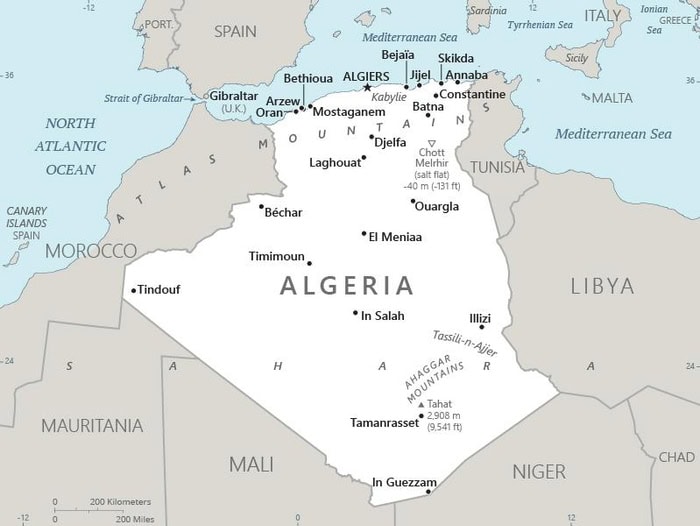
Algeria is a north African country which has borders with Tunisia and Libya to the east; Niger and Mali to the south; Mauritania and Western Sahara to the south west; and Morocco to the west. It has a northern coastline on the Mediterranean Sea. Since 2011 (when Sudan and South Sudan split to become two independent nations) Algeria has been the largest country on the continent of Africa by area.
For several centuries Algeria, like much of north Africa, was part of the Roman Empire. Having suffered attack by the Germanic Vandals in the 5th Century it succumbed to Islam at the beginning of the 8th Century. In the 19th Century Algeria was conquered by France and a significant number of French people emigrated to the country. The 1950s saw prolonged conflict between the Algerian National Liberation Front and the French, which resulted in independence in 1962.
During the era of the Roman Empire Christianity made inroads in what is now Algeria. St. Augustine of Hippo (354 – 430), arguably the most influential individual Christian in the entire, post-New Testament history of the Christian Church, was born in Thagaste (now Souk Ahras), in the Berber region of Algeria. Having travelled to Rome and then to Milan (where he was famously converted to Christ), Augustine returned to Thagaste before visiting Hippo Regius (modern day Annaba on the coast) where he was ordained and eventually became Bishop. His writings, such as “On The Trinity”, “The City of God” and his autobiographical “Confessions” are among the most famous and influential Christian works ever written.
The 1990s saw a civil war in Algeria. This followed an electoral victory by Islamists in 1992 which was opposed by the military. It is estimated that as many as 100,000 people were killed in the conflict.
What it means to be a Christian in Algeria
Prior to independence Algeria was home to more than a million who would have identified as being from a Christian background (mainly French). The majority were evacuated to France in 1962. Today around 98% of Algeria’s 44 million population would identify as Sunni Muslim. Some would claim there has been a modest rise in Algerians calling themselves non-religious, particularly among younger adults.
Algeria’s constitution declares Islam to be the state religion, but also declares that freedom of “creed and opinion” should be maintained.
The Protestant Church in Algeria is small, and mainly confined to the Kabyle Berber ethnic group in the north of the country. In the past churches have generally been free to meet, although in recent years there have been periodic government crackdowns on Christians. Islamist groups in Algeria are increasingly intolerant of non-Muslim religion.
Persecution
Since 2006 Christian churches have been penalised under a law requiring religious communities to register with the national authorities. When applications to re-register have been ignored churches have been left in a situation where their meetings can be shut down. More than 40 churches in the Protestant Church of Algeria (EPA), an Evangelical, Reformed federation, have been forcibly closed in recent years.
As in many countries where Islam is the majority religion, evangelism among Muslims is opposed and those who come to faith in Christ from a Muslim background face hostility from family and neighbours. Muslim background believers meet and worship in homes or in secret.
Release International work
In response to increased pressure on the church across Algeria, Release International is working through partners to support church leaders and their families and to encourage them to stand firm.