Overview
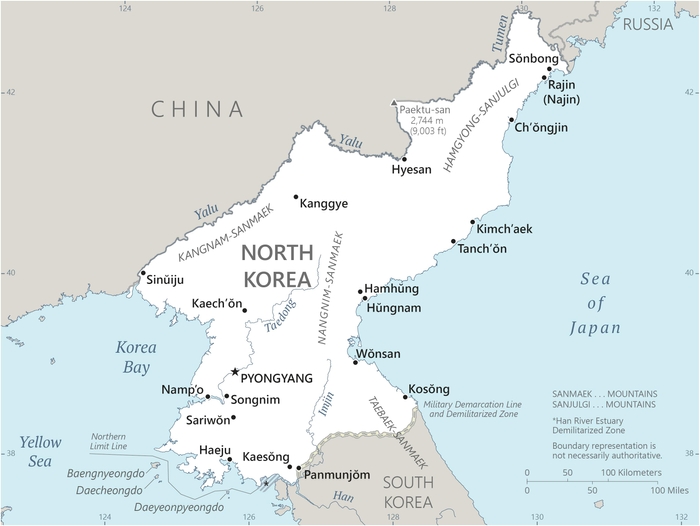
North Korea, or the Democratic People’s Republic of Korea, to give it its full official title, makes up the northern half of the Korean Peninsula. It borders mainly China plus a small part of Russia to the north. To the south a buffer zone, known as the Korean Demilitarized Zone, separates it from South Korea.
Having been annexed by Japan early in the 20th Century, Korea gained its independence after the Second World War, but was divided into two; the north being occupied by the Soviet Union and the south by the United States. Attempts at reunification failed and an invasion of the south by North Korea in 1950 launched the three-year Korean War. The North was supported by China and the Soviet Union; the South by the United Nations (and particularly the United States of America). A ceasefire agreement was established in 1953, but no formal peace treaty has even been signed.
Despite its official title, North Korea is a totalitarian dictatorship, dominated by a cult personality around the Kim dynasty, three generations of leaders of the country since the Second World War. Its only tolerated ‘religion’ (if it can be called that) is the ideology of Juche, a Marxist concept of ‘self-reliance’, developed by the country’s founder, Kim Il-Sung.
What it means to be a Christian in North Korea
Not for nothing is North Korea often referred to as the ‘Hermit Kingdom’. It remains one of the most isolated and repressive countries in the world. Officially North Korea is an atheist state.
It is hard to believe now but early in the 20th Century the northern part of Korea was a thriving centre of Christianity and Pyongyang, now the capital of the North, was known as the ‘Jerusalem of the East’, because of the number of churches established there during a considerable revival. However, most Christians fled south during the Korean War, or were martyred and their churches destroyed.
Today Christianity is seen to pose a direct threat to the primacy and authority of the state and, in particular, the Kim dynasty and, as a result, exists very much underground. The true numbers and extent of Christian faith in North Korea are almost impossible to gauge.
Persecution
The persecution of Christians in North Korea is extremely severe. Anyone discovered to be a professing Christian, or anyone simply expressing any interest in Christ or in the Bible, is considered to be an enemy of the state.
Christians who are discovered can be sent to concentration camps, where they face starvation and torture. The government requires that all North Koreans express their loyalty by acting as state informers and children are taught to spy on their parents from a young age. This means North Korean Christians must be extremely careful in what they say and do. If an individual Christian is arrested his or her entire family face punishment.
Release International work
Release International supports a one-year discipleship programme for those who have defected from North Korea to the South. This work comprises weekly biblical discipleship classes, home visits, field trips to locations of Korean Christian martyr history and lectures from guests directly involved with the persecuted church.
The aim of the work is to help both seekers (who have defected because of the oppressive nature of the North Korean regime) and believers to settle into life as Christians in South Korea; to avert the all-too-common culture shock of now living in a free society where information is not controlled and sanctioned by the state; and to provide training to those with a vision and desire to reach out to Christians still in North Korea.