Overview
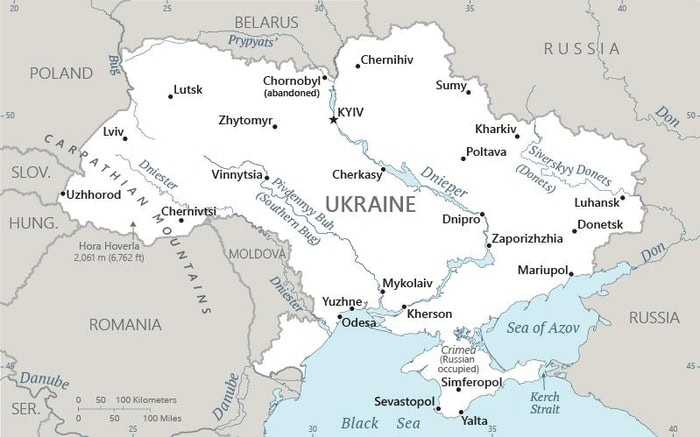
The mineral-rich country of Ukraine is Europe’s second largest country by area (after Russia) and has a population of nearly 42 million. It borders Russia to the east and north-east and also shares borders with Belarus, Poland, Slovakia, Hungary, Romania and Moldova.
The land that is now Ukraine has had a varied history, but it was part of the old Soviet Union until 1991, when the dissolution of the latter saw Ukraine gain its independence.
Since that time its relationship with Russia to the east and Europe to the west has fluctuated. In 2013 the government of President Viktor Yanukovych suspended the then Ukraine-European Union Association Agreement and sought closer ties with Russia. This in turn led to a series of demonstrations and protests within the country that eventually led to the Ukrainian parliament voting to remove Yanukovych from office. This in turn led to the annexation of the Crimean peninsula by Russia in 2014. It also marked the beginning of conflict in the Donbas region to the south east (made up of the administrative areas of Donetsk and Luhansk) between separatist forces and the new Ukrainian government. This protracted conflict provided the backdrop to Russia’s invasion of Ukraine in February 2022.
What it means to be a Christian in Ukraine
Christianity has a long and strong history in Ukraine. As such the church suffered extensive persecution under the Communism of the Soviet era. Since independence Ukraine has enjoyed freedom of religion. Christianity is the largest religion in the country, with the majority identifying with one of the strands of the Orthodox church. Protestants make up less than 5% of the population.
Persecution
The build-up to Russia’s invasion of Ukraine in 2022 threw a fresh spotlight on the nation of Ukraine and some of its regional tensions. In particular, in the two separatist areas of Donetsk and Luhansk there has been a marked erosion of religious freedom since 2014.
The persecution of Christians in the Ukrainian territories occupied by Russia since 2022 has been systematically increasing. Ukrainian Evangelicals have been forced to go underground, with 95% of church buildings in those areas being seized by the occupiers. Believers have met in small groups in homes, but Russians have been raiding those groups. Christians have been harassed, detained and deported. Having any connection with Western Christians is strictly forbidden.
Only the Moscow Orthodox Church, a puppet institution in the hands of the Russian authorities, is recognised. All other Ukrainian churches have been closed down. To function even in a very limited form, Ukrainian Christians in the occupied territories are obliged to obtain Russian citizenship and to register their churches under restrictive Russian law. Many Ukrainian Christians have already fled the territories occupied by Russia.
Release International work
Release International currently has two projects in Ukraine. The first supports frontline workers, carrying out evangelistic and pastoral work, as well as providing humanitarian aid for victims of the current war. The second project seeks to encourage Christian leaders who have experienced trauma. Regular retreats are held to enable them to regain their strength and renew their hope.