Overview
The Republic of Iraq is a country that has experienced great turbulence and change in the past century.
In the ancient world the area was known as Mesopotamia (meaning ‘between two rivers’; a reference to the Tigris and the Euphrates). The ancient city and empire of Babylon (prominent in the Old Testament) was in this region.
Modern-day Iraq dates back to 1920, when a post-World War One British Mandate was created under the authority of the League of Nations, following the defeat of the Ottoman Empire. The Hashemite Kingdom of Iraq subsequently gained its independence from Britain in 1932. The monarchy was eventually overthrown in 1958 and a republic established.
The 1960s saw the emergence of the Arab Socialist Ba’ath Party, which gained control of the country in 1968 following a coup. Saddam Hussein became President in 1979. The following year Iraq invaded – and fought an eight year war with – neighbouring Iran. In 1990 Iraq annexed Kuwait, which prompted the first Gulf War.
In 2003 a coalition led by the United States invaded Iraq, claiming it had refused to abandon so-called ‘weapons of mass destruction’, and with the intent of deposing Saddam Hussein. Two years later elections took place and a new constitution was approved. However, the country descended into growing instability, with the emergence of various jihadist insurgencies and on-going violence between Sunni and Shi’a Muslims. This increased following the withdrawal of US troops in 2011 and included the emergence of the Sunni Muslim terrorist group Islamic State. Iraq remains politically unstable.
What it means to be a Christian in Iraq
Christianity has a long tradition in Iraq. Prior to the first Gulf War Christians constituted a sizeable minority of Iraq’s population and Christianity was tolerated under Saddam Hussein’s Ba’athist regime.
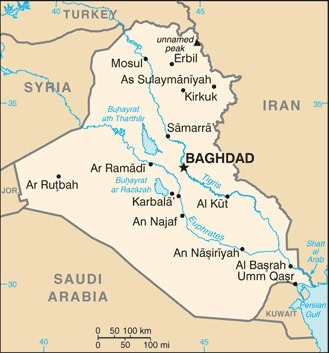
It is estimated that there were more than 1.5 million Christians in Iraq at the turn of the century. Twenty five years later that number had shrunk to less than a quarter of that amount. In the chaotic years following the 2003 invasion and the subsequent rise of Islamic State and other Islamist insurgent militia many Christians have fled the country – or have fled to Kurdistan, a region straddling the boundaries of Iraq, Iran, Syria and Turkey.
Persecution
After taking the northern city of Mosel from the Iraqi governmental forces, Islamic State demanded that Assyrian Christians living in the city either convert to Islam, pay the ancient jizyah (a tax enforced on non-Muslims living in a state governed by Islamic law) – or face execution. Those who refused to comply had to leave the region. Similar conditions were imposed in other towns and cities.
Later the Islamic State’s capture of the mainly Assyrian towns of Qaraqosh, Tel Keppe, Batella and Karamlish saw more than 100,000 Iraqi Christians flee their homes, leaving virtually all their property behind.
Release International work
The autonomous region in the north known as Kurdistan is a rare haven of religious tolerance. For that reason is has attracted Christians fleeing persecution and war, whether from Islamic State, Syria’s long civil war or on-going tensions and persecution in Iran. Release International supports a church-based ministry which provides food relief parcels to Syrian-war widows. It also produces and distributes Bibles and other Christian literature in the Kurdish language, and provides discipleship for Iranians and others who have fled to the region.
A second strand of Release International work in Iraq supports the ministry costs of St George’s Church in Baghdad (Operation Haggai). The church, along with its attached health clinic, is uniquely placed to advocate for the power of the Christian gospel to bring real reconciliation; its compassionate service and strategic influence even being recognised by the Iraqi government.