Overview
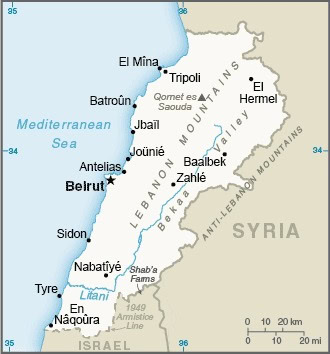
The Republic of Lebanon is a west Asian country with a coastline on the Mediterranean Sea and land borders with Syria to the north and east and Israel to the south. Partly because of its geography it has a long, rich and diverse history, culturally and religiously. In New Testament times it was part of the Roman Empire and became a major centre for the early spread of Christianity. Later it succumbed to Muslim conquest and eventually became part of the Ottoman Empire. Following that empire’s collapse at the end of World War I modern day Lebanon came under the French Mandate for Syria and Lebanon. The country gained its independence in 1943.
A 15-year long civil war broke out in 1975 and since that time the country has also been subject to military occupation of parts of its land by Syria and Israel. More recently the country has faced a serious financial crisis, which was exacerbated by the Covid-19 pandemic and the Beirut port explosion in August 2020.
Lebanon is the most religiously diverse country in the Middle East. A census in 1932 suggested that about 53% of the population was Christian. Although no official census has been carried out since then, higher birth rates among the Muslim population and, in particular, large-scale emigration of Christians has undoubtedly lowered that proportion, although the numbers of Christians in Lebanon is disputed and is difficult to gauge. But because of its significant Christian population and its relative freedom of worship, it has become a haven for displaced Christians in the region.
What it means to be a Christian in Lebanon
The Maronite Church (an Eastern branch of Catholicism) and the Eastern Orthodox constitute the largest denominations. Protestants are reckoned to make up about 1% of the population. The country’s constitution provides for freedom of religion.
Religion does play a significant part in public and political life in Lebanon. The country’s National Pact, drawn up in 1943, seeks to maintain a political balance among religious groups, but has been criticised for creating inefficiency and cementing sectarian division.
Persecution
Lebanon’s main urban areas are westernised but outside the more prominent cities Christians often face significant opposition and threats, particularly in Muslim-majority areas. More severe forms of persecution occur when Christians share their faith and, in particular, when Muslims come to faith in Christ. Christian converts from a Muslim background face persecution from family and the local community. Various Islamist extremist groups, including the political militant group Hezbollah, actively persecute Christians.
Release International work
Release International supports a local church which engages in discipleship work among believers from both Christian and non-Christian backgrounds, including Lebanese Christians and those from neighbouring countries – particularly Syria (Operation Ruth). Many of the latter need encouragement to persevere in their new faith, in the face of persecution. New believers are equipped to share the gospel with others in their community.