Overview
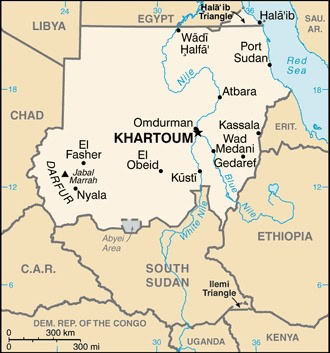
Sudan (officially the Republic of Sudan) is a north-eastern African country which has borders with Egypt to the north, Eritrea and Ethiopia to the east and southeast, Chad and Central African Republic to the west and southwest and – since 2011 – South Sudan to the south. Sudan was run jointly by Egypt and Britain from the end of the 19th Century until the country gained its independence in 1956. The country then endured prolonged conflict between the largely Islamized north and the non-Arab south. The 1970s saw a period of relative peace, before fighting broke out again in the 1980s. In 1989 Colonel Omar al-Bashir led a bloodless military coup, which resulted in the suspension of political parties and the introduction of an Islamic legal code. In 2005 a peace agreement was signed which ended hostilities, gave some limited independence to the people in southern Sudan, and paved the way for a referendum on independence.
Until 2011 Sudan was the largest country by area in Africa. That year, as the result of a referendum, southern Sudan gained independence to become South Sudan.
What it means to be a Christian in Sudan
Christianity has a long history in the areas of what are now both Sudan and South Sudan. However, as a result of the separation in 2011, about 97% of the population of Sudan would now be identified as Muslim. By contrast about 60% of South Sudan’s population would be considered Christian.
In April 2019 Omar al-Bashir, who had been in power since 1989, was overthrown in a coup d’état, which saw him replaced by a transitional military council. A renewed constitution guarantees freedom of religion and omits references in the previous constitution to Islamic Sharia as a source of law. Apostasy from Islam was decriminalised in 2020. Previously those found guilty could face the death penalty. Sudanese Christians can attend church services openly, but activities which threaten Islam’s dominance can still lead to Christians (especially leaders) being detained and imprisoned.
Persecution
Christians have suffered brutal persecution over many years in Sudan. This began to escalate after the mid-1980s, since when the country’s leadership has carried out a campaign to Islamize the nation. This led to the destruction of church buildings and villages and the imprisoning of Christians. This campaign extended to the bombing of villages, hospitals and churches, in an effort to exterminate Christians in the Nuba Mountain, Blue Nile and Darfur regions that border the now independent state of South Sudan.
In December 2015 Czech-born Petr Jasek, who works for a sister ministry of Release International, was arrested in Sudan’s capital of Khartoum as he prepared to fly home after spending some time in the country visiting persecuted Christians. Charged with espionage, waging war against the state, and undermining the constitution, he went on to spend 445 days in prison, before his release was negotiated. His story is told in the book Imprisoned with ISIS (Available from our eStore).
Release International work
Release International supports the work of a sister ministry, which provides essential medicines, family med-packs, and other resources to Christian families in the Nuba mountains who have, in the past, suffered frequent and intense attacks.